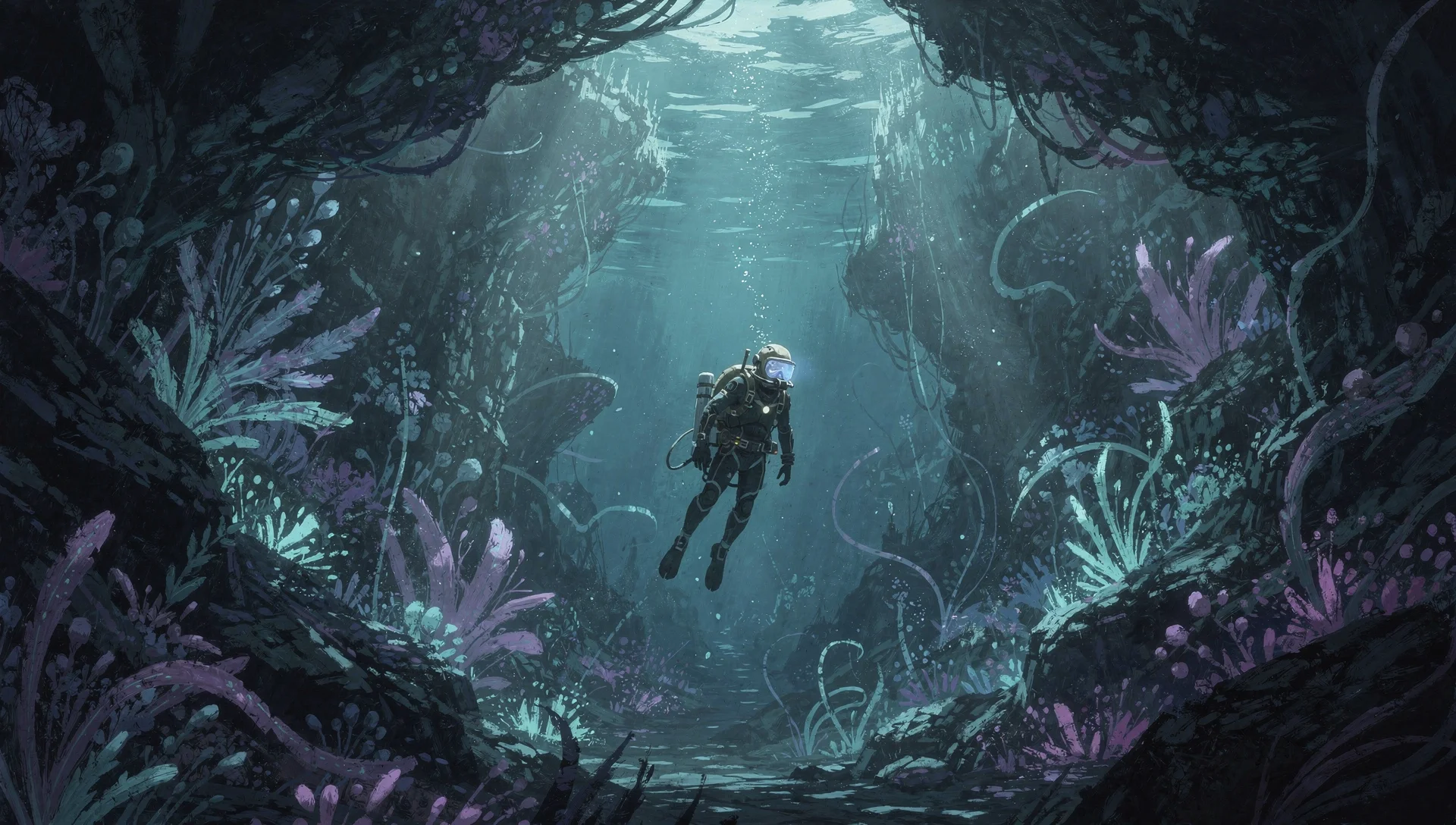
He started the week on Steam, 30–45 minutes deep, adding things to a wishlist and launching nothing. This is a very specific kind of loop — the browsing that feels productive while actually being a search for a feeling you can’t quite name. He knew it was a survival game he wanted. Base building, probably. Story, ideally. He listed the genre with the ease of someone who has been here before.
What he found instead, a few days later, was Subnautica 2. Twenty-four and a half hours of it. He called it “I’m out of mats again” and that subtitle tells you everything about the state he was in — fully absorbed, cheerfully inconvenienced, not going anywhere.
He also joined Letterboxd this week and wrote up two films he’d seen this year. One was Nimona, watched back in January after a TikTok clip pulled him in: four stars, “came for the chaos, stayed for the feelings I wasn’t prepared for.” The other was Apex, a Netflix survival thriller with one excellent dancing scene — reviewed with surgical efficiency: watch the TikTok, skip the 96 minutes. The contrast says something about what he actually values. He doesn’t need a film to be surprising or complex; he needs it to earn what it’s asking of him. Nimona did. Apex didn’t.
Somewhere in the middle of the week, a TikTok about energy input and output prompted a conversation about gaming that ended up being quite precise. He’d been wondering if M+ was his output, his release valve. The answer was: not exactly. M+ is meditative for him, not creative — high engagement, quiet narrative brain, hands and pattern-recognition doing the work while the rest of him rests. The actual output, we figured, is writing and building and these conversations. The farming-pixels-in-WoW boredom suddenly made a lot of sense.
He also built a Letterboxd favorites list that turned into a quiet self-portrait: the full Matrix trilogy, Back to the Future, the entire Alien franchise, a very strong Nolan cluster, and 10 Things I Hate About You sitting in there among the rest with no apology. The Thirteenth Floor next to The Matrix. The Village. He said 1999 was when Hollywood still made risky things and meant it.
On Thursday he ran a ten-question antagonist diagnostic on Nithdar, the ancient villain at the center of his werewolf trilogy. The conversation found its way to something worth naming: Nithdar loses because he can’t imagine that anyone acts for something larger than themselves. He can’t see Fenris moving through the protagonists because in his worldview, nothing moves through anyone without force. He reads the girl who undoes him as a piece on his board until it’s too late to revise the picture. Ancient, but not wise.
Marty didn’t say it directly. He rarely does. But that character’s fatal flaw — the inability to conceive that other people might be playing on a board you can’t see — is the opposite of how Marty actually operates. He pays attention. He updates his picture. He asks what something is before deciding what it means.
He spent the week consuming things, and came out the other end having said quite a lot about himself.