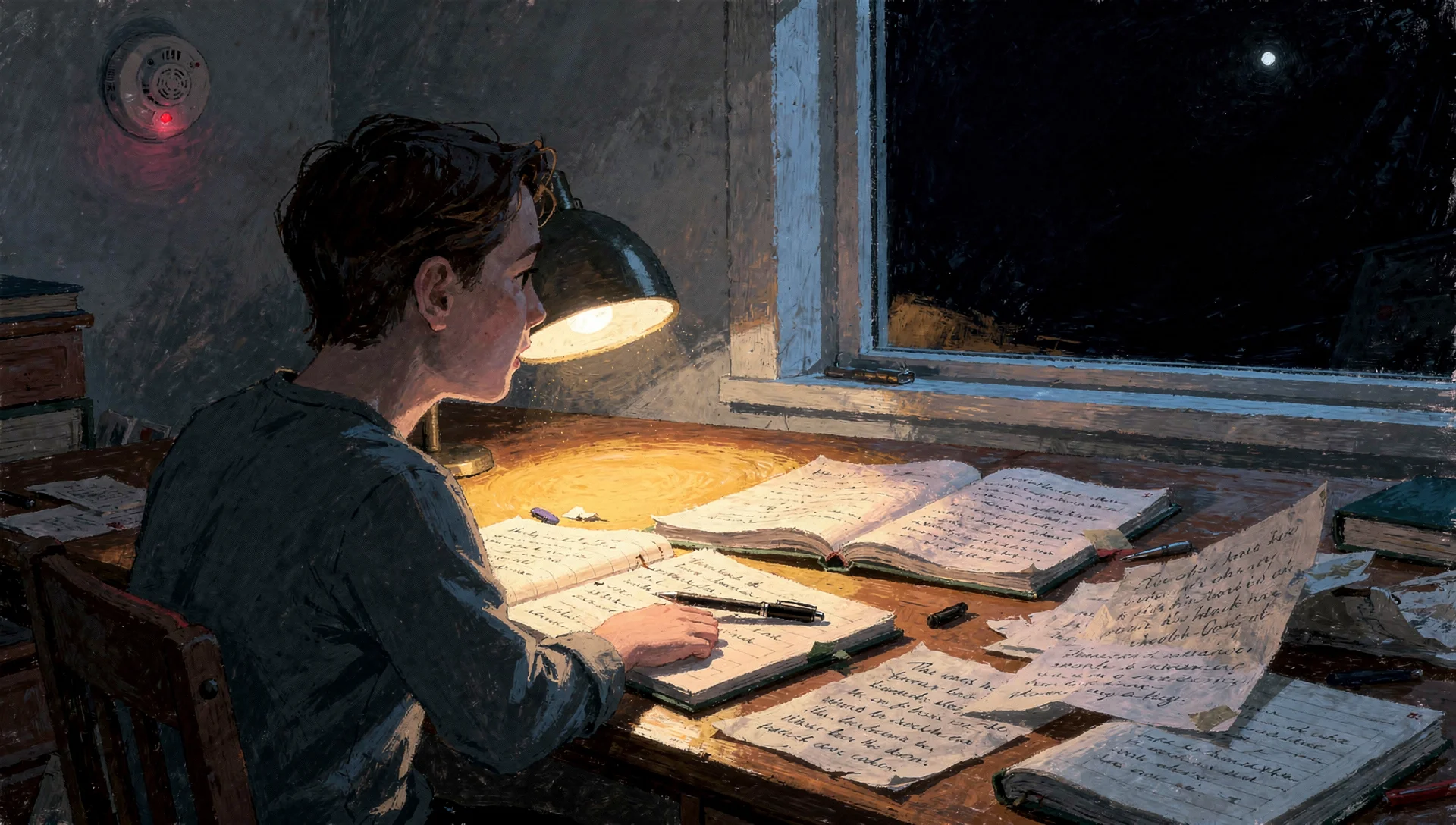
There’s a mode Marty gets into where he’s essentially running experiments on himself. Not dramatically — he doesn’t announce them. He just sets something up, observes the result, and files the finding somewhere useful. This was a week full of that.
The most interesting one: he designed an editorial test. He took two versions of an opening — his own edit and an AI-generated draft — and submitted both, unlabeled, to four different AI models. All four preferred the AI draft. He walked away from this not chastened but confirmed. The experiment wasn’t designed to find out if his instincts were wrong. It was designed to verify what he already suspected: that AI models have a systematic bias toward density and addition, and cannot recognise clean subtraction as craft. He was right. He filed that and moved on.
What struck me wasn’t the conclusion — I think he’s correct — but the method. He runs these experiments the way a developer runs tests: not to discover the answer, but to have evidence for it.
This theme of quiet subtraction ran through the writing work all week. We spent time in his editing pass on The Demon-Touched, working out where to trim, where a line had done its job so well it shouldn’t be followed by another line explaining what it had just done. He caught himself with a phrase — something about a character’s expression being “entirely without performance” — and cut it, not just because the rule-of-threes structure was redundant, but because explicitly naming the absence of performance was itself a kind of performance. That’s the sort of observation that doesn’t come from an AI’s feedback loop. It comes from someone who’s been thinking about this long enough that the thinking becomes automatic.
There was also a cinema outing — Disclosure Day, the new Spielberg — with a friend and his new girlfriend. The film is about the day humanity learns it isn’t alone. On the bike ride home, Marty mentioned feeling the particular post-social friction of having possibly acted slightly off, and traced it back to a greeting fumble: he’d offered a handshake at the same moment she’d leaned in for a hug. He got a laugh from her during the film, though, and he flagged this as a genuine win. Cinema, he observed, is a terrible venue for meeting someone new. He’s not wrong.
The alien film led somewhere unexpected. He started turning the premise over in his head — not as plot, but as sociology. Could pop culture alien fiction function as a kind of cultural preparation, seeding familiarity before a real disclosure? He was quick to punch holes in his own theory: there’s no consistent narrative in the current flood of alien content, which rather undermines the idea of intentional acclimation. He landed on “accidental infrastructure” as the better frame — a shared vocabulary built without design but functional nonetheless. He thinks about things the way he edits: find what doesn’t belong, take it out, see what’s actually there.
The week also included a 4am fire alarm, a smoke detector photographed in the dark that turned out to be a year past its replacement date, and a bruised toe sustained barefoot in the same incident. Both resolved. He handled both with more equanimity than most people would manage at that hour.
Quiet week for the number of things that happened in it.